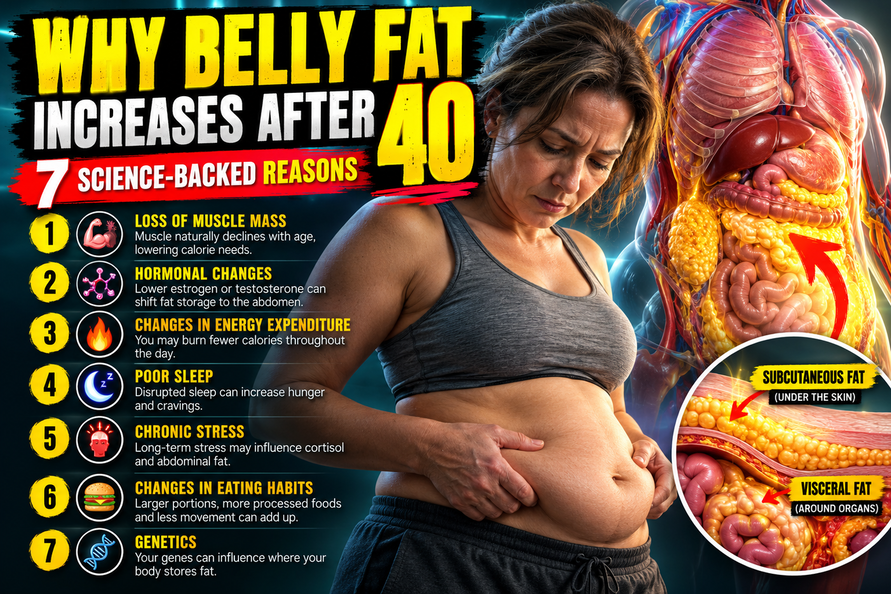
Why does your waistline sometimes change even when your eating habits haven’t? The answer involves more than calories. Aging, hormones, muscle mass, sleep, and fat distribution can all influence what happens around your abdomen.
You may have noticed something frustrating after turning 40.
Your clothes fit differently. Your waistline seems thicker. And the habits that once helped you maintain your weight don’t always produce the same results.
But here’s what many people overlook:
Your body composition can change even when the number on the scale barely moves.
Understanding why belly fat increases after 40 means looking beyond body weight and examining how the body stores fat, maintains muscle, and responds to hormonal and lifestyle changes.
Let’s explore seven important factors supported by scientific research.
Table of Contents
1. Age-Related Changes in Muscle Mass
One important reason belly fat may increase after 40 is the gradual loss of skeletal muscle.
Muscle plays a major role in movement, strength, blood glucose regulation, and energy expenditure.
As people age, muscle mass can decline, especially without regular resistance exercise.
Because muscle contributes to the body’s resting energy requirements, losing muscle may reduce daily calorie needs.
Over time, this can make weight management more challenging if food intake and activity remain unchanged.
However, muscle loss is not inevitable at the same rate for everyone.
Regular strength training, adequate nutrition, and consistent physical activity can help preserve muscle mass as you age.
The important distinction: A changing waistline may reflect both increasing body fat and decreasing muscle, not simply an increase in total body weight.
2. Hormonal Changes and Fat Distribution
Hormones help regulate where fat is stored throughout the body.
During midlife, changes in reproductive hormones can influence body fat distribution.
For women, declining estrogen during the menopause transition is associated with a greater tendency to accumulate fat around the abdomen rather than the hips and thighs.
Research suggests that menopause can change body composition even without a dramatic increase in total body weight.
Men also experience hormonal changes with aging, although the patterns and effects differ.
Testosterone levels may decline gradually, and changes in hormonal health can interact with muscle mass, activity, and body composition.
But hormones are not the only explanation.
Aging, genetics, lifestyle, and overall energy balance all influence fat accumulation.
This is why two people of the same age may experience very different changes in their waistlines.
3. Changes in Daily Energy Expenditure
You may have heard that metabolism suddenly slows down after 40.
The reality is more complicated.
There is no universal metabolic switch that activates on your 40th birthday.
Instead, changes in muscle mass, physical activity, body composition, and daily routines can gradually affect how much energy your body uses.
For example, someone who spends more time sitting and less time moving may burn fewer calories throughout the day.
Even if their eating habits remain similar, their energy requirements may be different from what they were years earlier.
This does not mean that weight gain after 40 is unavoidable.
It means understanding your changing activity patterns and body composition may be more useful than assuming your metabolism is permanently damaged.
4. Poor Sleep and Appetite Regulation
Sleep is an often-overlooked factor in body composition.
Insufficient or disrupted sleep can influence appetite, food choices, energy levels, and metabolic regulation.
When people consistently sleep poorly, they may experience increased hunger, stronger cravings for energy-dense foods, and reduced motivation for physical activity.
Sleep problems may become more common during midlife because of work demands, stress, caregiving responsibilities, or hormonal changes.
For some women, menopause-related symptoms such as night sweats can further disrupt sleep.
Research links inadequate sleep with weight gain and unfavorable changes in body composition.
However, poor sleep does not automatically cause abdominal fat accumulation in every individual.
Supporting healthy sleep is one important part of a broader metabolic health strategy.
5. Chronic Stress and Cortisol
Stress is another factor worth understanding.
When you encounter a stressful situation, your body activates systems designed to help you respond.
One of the hormones involved is cortisol.
Cortisol has essential functions, including helping regulate metabolism, blood pressure, and the body’s response to stress.
The problem is not cortisol itself.
Rather, prolonged stress and disrupted stress-response patterns may influence sleep, appetite, eating behavior, and metabolic health.
Some research also links chronic stress and altered cortisol regulation with abdominal fat accumulation.
But the relationship is complex.
Not everyone experiencing chronic stress gains belly fat, and abdominal fat is not proof that someone has elevated cortisol.
Stress-related weight changes can also involve reduced physical activity, changes in food intake, medication effects, and sleep disruption.
This makes stress management a useful component of overall health, without treating it as a guaranteed solution for belly fat.
6. Changes in Eating Habits and Physical Activity
Many changes in body composition develop gradually.
A more sedentary job, longer working hours, fewer recreational activities, or increased family responsibilities can reduce daily movement.
At the same time, eating patterns may shift.
Larger portions, frequent snacking, calorie-containing drinks, and highly processed foods can make it easier to consume more energy than the body requires.
These changes are not always obvious.
And they don’t necessarily happen because someone lacks discipline.
The environment, daily routines, access to healthy foods, stress, and available time all influence behavior.
Research consistently supports physical activity and sustainable dietary improvements as important tools for managing body composition.
The goal is not extreme restriction.
It is developing realistic habits that support long-term health.
7. Genetics and Individual Fat Distribution
Have you ever wondered why some people gain weight primarily around their abdomen while others store more fat around their hips or thighs?
Genetics helps explain part of this difference.
Inherited factors influence body shape, fat distribution, appetite regulation, and susceptibility to weight gain.
Age and hormonal changes interact with these inherited characteristics.
This means two people following similar routines may still have different body compositions.
Genetics does not determine every outcome.
However, it helps explain why comparing your body with someone else’s may not provide an accurate picture of your health.
Why Belly Fat Location Matters
Not all abdominal fat is stored in the same location.
Two important types are subcutaneous fat and visceral fat.
| Subcutaneous Fat | Visceral Fat |
|---|---|
| Located directly beneath the skin | Located deeper within the abdominal cavity |
| Helps store energy and provide insulation | Surrounds internal organs |
| Has important protective and metabolic functions | Has important metabolic functions but excess accumulation is associated with health risks |
| Can often be gently pinched | Cannot be directly measured by pinching the abdomen |
Higher amounts of visceral fat are associated with increased risks of insulin resistance, type 2 diabetes, and cardiovascular disease.
However, visceral fat is not inherently harmful at every level. Its effects depend on the amount, metabolic environment, and individual health circumstances.
You also cannot reliably determine visceral fat levels simply by looking in the mirror.
Related reading: Visceral Fat vs Subcutaneous Fat: What’s the Difference After 40?
What Helps Support Healthier Body Composition After 40?
Although aging affects the body, there are practical ways to support metabolic health.
Prioritize Strength Training
Resistance exercise helps preserve and build muscle mass, maintain physical function, and support healthier body composition.
Stay Physically Active
Walking, cycling, swimming, and other aerobic activities can support cardiovascular health and energy expenditure.
Combining aerobic activity with strength training offers complementary benefits.
Eat a Balanced, Nutrient-Rich Diet
Include adequate protein, fiber-rich foods, vegetables, fruits, whole grains, and appropriate portions.
Individual nutritional requirements vary depending on health status, activity, and other factors.
Protect Your Sleep
Maintain a consistent sleep schedule and address persistent sleep problems rather than ignoring them.
Manage Chronic Stress
Mindfulness, relaxation exercises, supportive relationships, physical activity, and professional support when needed can help improve stress management.
Monitor More Than Body Weight
Waist circumference, strength, fitness, blood pressure, blood glucose, and cholesterol can provide additional information about health.
No single measurement tells the whole story.
The Bigger Picture: Your Body Is Changing, Not Failing
Belly fat after 40 is not explained by one hormone, one food, or one lifestyle habit.
It reflects a combination of biological and environmental influences.
Muscle mass may change.
Hormonal patterns may shift.
Sleep and activity may become less consistent.
And inherited characteristics influence how each person responds.
Understanding these factors can help you make better-informed decisions rather than chasing quick fixes.
The goal is not simply a smaller waistline. It is better metabolic health, preserved muscle, and long-term well-being.
Frequently Asked Questions
Is belly fat inevitable after 40?
No. Although aging can influence body composition, abdominal fat gain is not inevitable. Physical activity, nutrition, sleep, genetics, and hormonal factors all play roles.
Does metabolism suddenly slow down at 40?
No. There is no universal sudden metabolic slowdown at age 40. Changes in activity, muscle mass, and body composition can affect energy needs over time.
Can you gain visceral fat without gaining much weight?
Yes. Body fat distribution and muscle mass can change even when total body weight remains relatively stable.
Does cortisol cause belly fat?
Cortisol is involved in metabolic regulation, and prolonged stress may contribute to weight-related changes. However, cortisol is not the sole explanation for abdominal fat, and belly fat alone cannot diagnose a cortisol problem.
What exercise is best for belly fat after 40?
A combination of aerobic activity and resistance training can improve body composition and metabolic health. No exercise can reliably target fat loss from one specific body area.
Can sleep affect abdominal fat?
Insufficient sleep may influence appetite, food intake, activity, and metabolic processes. Improving sleep supports overall health, although its effects on body fat vary between individuals.
Explore the Hidden Science of Belly Fat
Understanding why belly fat increases after 40 is only the beginning.
The next question is where that fat is stored — and why its location can matter for metabolic health.
Explore our Research Library for educational resources on body composition, metabolism, and healthy aging.
About this article: Published by THE FAT DECEPTION, an independent educational project exploring metabolism, body composition, and healthy aging through scientific research and visual storytelling.
Scientific References
Scientific References
Leave a Reply