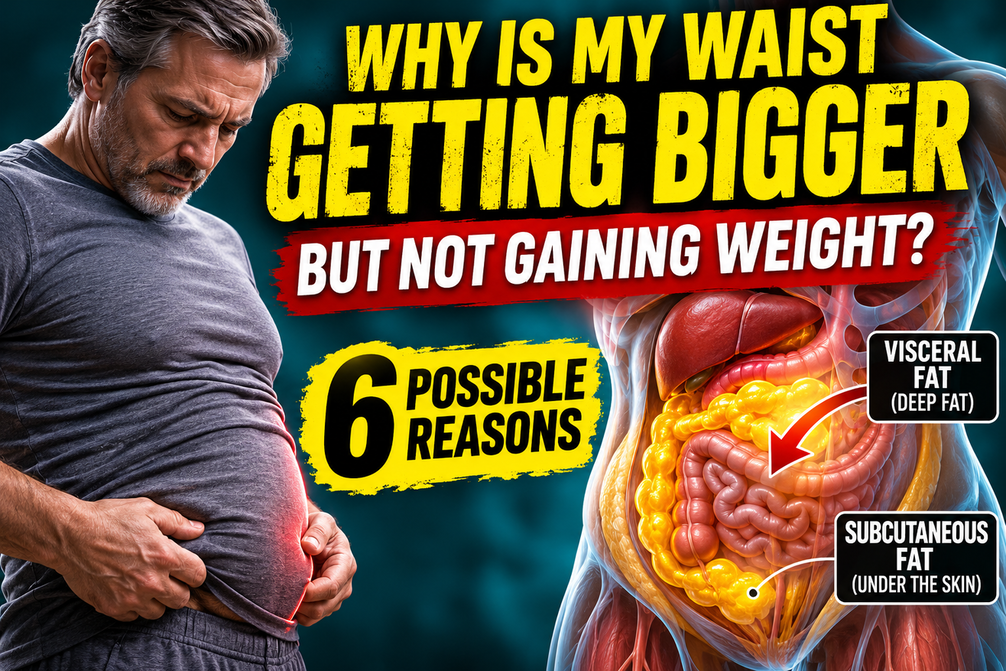
Why is my waist getting bigger but not gaining weight? If your clothes feel tighter around your stomach but the bathroom scale barely changes, there may be several explanations. Changes in body composition, digestion, fluid retention, and even how you measure your waist can affect its size without producing an obvious change in body weight.
You step onto the scale and see almost the same number as last month.
Yet your waistband feels tighter. Your stomach seems more prominent. Perhaps you’ve even moved up a clothing size.
It can be confusing when your body appears to be changing but your weight doesn’t reflect it.
The important distinction is that body weight and waist circumference measure different things. Your weight represents your total mass, while your waist measurement reflects the size of one area of your body.
A larger waist does not automatically mean you’ve gained visceral fat. Let’s examine six possible explanations and how to recognize when a change deserves medical attention.
1. Your Body Composition May Be Changing
One possible explanation for a bigger waist without weight gain is a change in the proportions of muscle and fat in your body.
Body composition describes how much of your body consists of fat, muscle, bone, water, and other tissues.
Imagine someone loses a small amount of muscle while gaining approximately the same amount of fat. Their total weight might remain relatively stable, even though their body shape changes.
This is possible because muscle and fat have different densities and distributions.
Muscle tissue is denser than fat tissue, so equal weights occupy different volumes. However, that doesn’t mean every change in waist size is caused by muscle loss.
Changes in physical activity, resistance training, diet, and aging can all influence body composition over time.
What to notice: If your waist has gradually changed over months while your strength or muscle mass appears to have declined, body composition may be worth discussing with a healthcare professional.
2. Abdominal Bloating Can Make Your Waist Temporarily Larger
Not every increase in abdominal size involves body fat.
Bloating can cause your abdomen to feel full, tight, or swollen. Sometimes the abdomen becomes visibly larger, a condition known as abdominal distension.
Digestive gas and abdominal bloating can make your waist appear larger even when your body weight remains relatively unchanged. The National Institute of Diabetes and Digestive and Kidney Diseases (NIDDK) explains how gas-related symptoms can cause bloating and abdominal distension.
Possible contributors include:
- Gas produced during digestion
- Constipation
- Difficulty digesting certain carbohydrates
- Irritable bowel syndrome
- Swallowing excess air while eating or drinking
Abdominal bloating does not necessarily mean you have gained abdominal fat. According to MedlinePlus abdominal bloating may be associated with digestive gas, constipation, and other gastrointestinal conditions.
For some people, abdominal size changes noticeably throughout the day.
Your stomach may appear flatter in the morning and larger after meals. This pattern may suggest digestive distension rather than a rapid increase in abdominal fat, although it cannot establish the cause by itself.
What to notice: Pay attention to whether the change varies with meals, bowel movements, or digestive discomfort.
Persistent or worsening bloating should be evaluated rather than automatically attributed to diet.
3. Fluid Retention and Hormonal Fluctuations May Affect Your Abdomen
Your body constantly regulates water and electrolytes.
Temporary changes in fluid balance can influence how your abdomen feels and, in some circumstances, how large it appears.
Hormonal fluctuations, including those associated with the menstrual cycle, may contribute to bloating and fluid-related changes.
Certain medications and medical conditions can also affect fluid balance.
However, significant abdominal fluid accumulation is not the same as ordinary bloating. Fluid buildup inside the abdominal cavity, called ascites, can indicate an underlying medical problem.
A persistent increase in abdominal size should not be dismissed as water retention without considering other symptoms.
What to notice: Record whether abdominal swelling is temporary or persistent, and whether it occurs alongside swelling elsewhere, discomfort, or changes in breathing.
Seek prompt medical assessment for unexplained progressive swelling, especially with pain, shortness of breath, or other concerning symptoms.
4. Your Waist Measurement May Be Inconsistent
Sometimes the apparent change is partly related to how your waist is measured.
A measuring tape placed slightly higher or lower can produce a different reading.
Other factors include:
- Measuring before breakfast one day and after dinner another
- Pulling the tape tighter during one measurement
- Measuring over different clothing
- Holding your breath or drawing in your stomach
- Standing differently
The Centers for Disease Control and Prevention recommends measuring around the middle of your body, just above the hip bones, and recording the measurement after breathing out.
For meaningful comparisons, consistency matters more than repeatedly checking your waist throughout the day.
How to Measure Your Waist Consistently
- Stand upright in a relaxed position.
- Locate the area just above your hip bones.
- Wrap a flexible measuring tape around your waist.
- Keep the tape horizontal and snug without compressing your skin.
- Breathe out normally before reading the measurement.
- Record the result and repeat future measurements under similar conditions.
If you are tracking a longer-term trend, use the same technique each time.
A single unexpected measurement is less informative than a consistent pattern.
5. Your Abdominal Shape and Posture May Be Changing
The appearance of your waist is influenced by more than the amount of fat stored around your abdomen.
Posture, abdominal muscle tone, and the way you hold your body can change how prominently your stomach projects.
For example, the position of the pelvis and spine can influence abdominal appearance when standing.
Changes in abdominal wall strength or muscle separation may also affect the shape of the midsection in some individuals.
These factors are not interchangeable with visceral fat accumulation.
A protruding stomach does not, by itself, reveal how much fat surrounds your internal organs.
What to notice: Consider whether your abdomen looks different when standing, sitting, or changing posture.
If you notice a new localized bulge, especially one associated with pain or strain, seek medical evaluation rather than assuming it is a posture issue.
6. Abdominal Fat Distribution May Change Even When Your Weight Is Stable
A final possibility is a change in where your body stores fat.
There are two major types of abdominal fat worth understanding.
Subcutaneous fat lies beneath the skin. It is the fat you can often pinch around your abdomen.
Visceral fat is stored deeper inside the abdominal cavity, around internal organs.
These types of fat are biologically different, and their distribution can be influenced by age, hormonal changes, genetics, and other factors.
A stable number on the scale does not rule out changes in abdominal fat distribution.
However, waist circumference alone cannot accurately determine how much visceral fat you have. It is a useful measurement, but not a direct scan of internal fat.
Tracking waist circumference alongside body weight can provide additional information about changes in abdominal size. The Centers for Disease Control and Prevention (CDC) provides guidance on healthy weight and waist circumference as part of assessing health risks.
For a deeper explanation, read our article Visceral Fat vs Subcutaneous Fat: What’s the Difference After 40?.
And if you’re interested in the broader effects of aging on abdominal fat, explore our companion article, Why Belly Fat Increases After 40: 7 Science-Backed Reasons.
How Can You Tell Whether Your Waist Is Really Getting Bigger?
Rather than relying on a single measurement or how your clothes fit on one particular day, look for patterns.
A simple observation record can help:
| What to track | What it may help you understand |
|---|---|
| Waist circumference | Whether your measurement changes over time |
| Body weight | Whether overall weight is stable or changing |
| Time of measurement | Whether readings are being compared consistently |
| Digestive symptoms | Whether bloating or constipation accompanies changes |
| Activity and strength | Whether your exercise routine or physical capacity has changed |
| Other symptoms | Whether medical assessment may be needed |
This information is not a diagnostic tool. It can, however, make a conversation with a healthcare professional more informative.
When Should You See a Doctor About an Increasing Waist?
A gradual change in waist size is not always a medical emergency, but unexplained abdominal enlargement should not automatically be attributed to aging or fat gain.
Arrange medical assessment if your abdomen continues to enlarge without an obvious explanation, particularly if the change persists.
Seek urgent care for severe or persistent abdominal pain, significant swelling with difficulty breathing, repeated vomiting, or other serious symptoms.
Also speak with a healthcare professional if abdominal changes are accompanied by unexplained weight loss, blood in your stool, or persistent digestive problems.
The purpose of investigating these symptoms is not to assume something serious is wrong. It is to distinguish ordinary fluctuations from conditions that may require treatment.
Frequently Asked Questions
Can your waist get bigger without gaining weight?
Yes. Waist circumference can change even when total body weight remains relatively stable. Possible explanations include changes in body composition, abdominal bloating, posture, or fat distribution.
Does a bigger waist always mean more visceral fat?
No. A larger waist does not prove that visceral fat has increased. Subcutaneous fat, digestive distension, and other factors can also affect abdominal size.
Why is my stomach flatter in the morning but bigger at night?
Changes associated with meals, digestive gas, and bloating may contribute to this pattern. If the swelling is persistent, painful, or worsening, seek medical advice.
Can you gain fat and lose muscle without changing weight?
Yes. If fat mass increases while muscle mass decreases by a similar amount, total weight may remain stable even though body composition changes.
Is waist circumference more useful than body weight?
Both measurements provide different information. Body weight reflects overall mass, while waist circumference helps assess abdominal size. Neither measurement alone fully describes body composition or health.
The Bigger Picture: Your Waist and Your Weight Tell Different Stories
If you’ve been wondering why your waist is getting bigger but you’re not gaining weight, remember that the scale provides only one piece of information.
Changes in body composition, digestion, fluid balance, posture, measurement technique, and abdominal fat distribution can all influence what you notice around your waist.
The goal is not to assume every change is fat gain or to become preoccupied with daily measurements.
It’s to understand your body more accurately, recognize meaningful patterns, and seek medical advice when changes are unexplained or persistent.
About this article: Published by THE FAT DECEPTION, an independent educational project exploring body composition, metabolic health, and healthy aging through scientific research and visual storytelling.
Medical disclaimer: This article provides general educational information and is not a substitute for individualized medical advice, diagnosis, or treatment.
Leave a Reply